Scriptoplay / Generative AI / Creative workflow
AI storytelling, made controllable.
I led product and UX design for an AI-native storytelling platform that evolved from script assistance into a structured script-to-production workflow. The core challenge was giving creators enough structure, context, and control to use generative AI without losing authorship.
Role
Product Designer & UX Lead
Period
Jun 2022 - May 2025
Engagement
Full-time
Industry
Film technology
Structure
Progressive creative workflow
Context
Persistent project intelligence
Control
Reviewable AI decisions
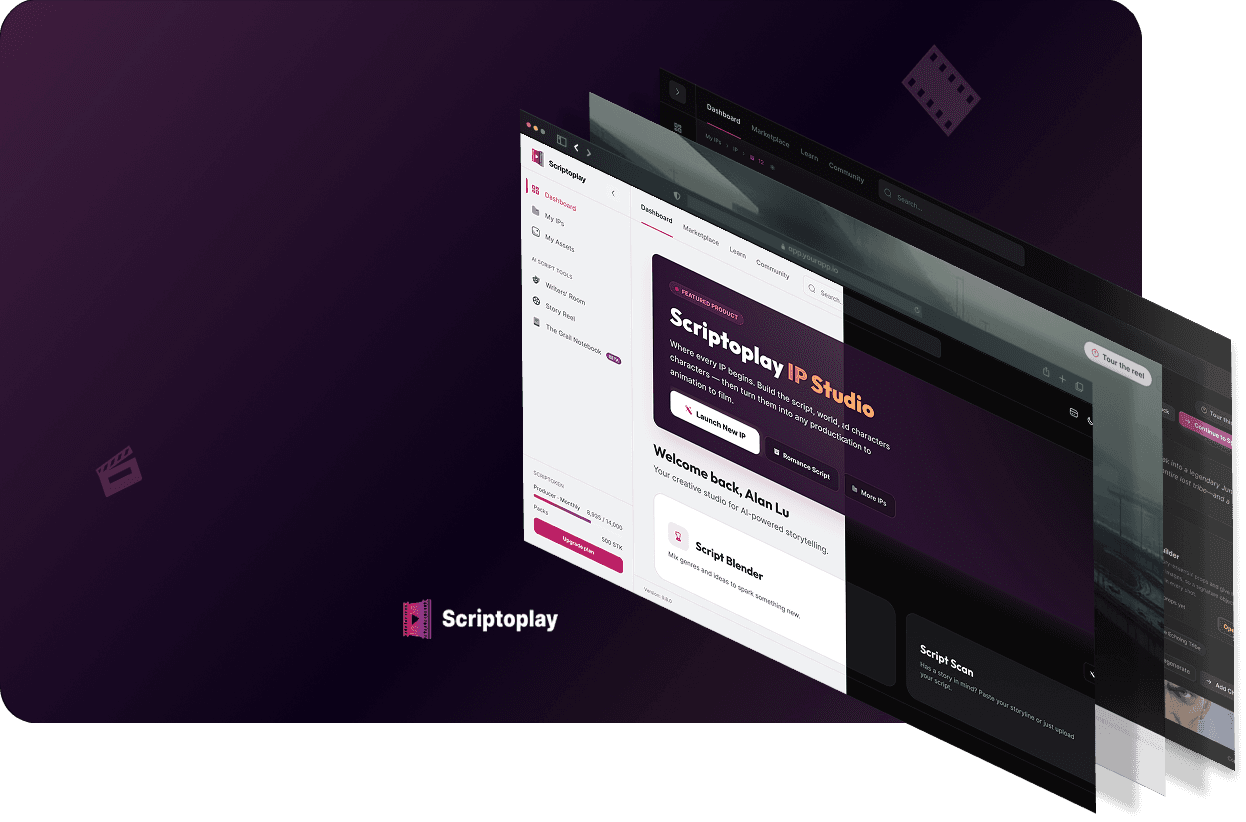
Define the product before the interface.
Creative work was being driven through open-ended chat and disconnected generation tools. Users could produce outputs, but they struggled to preserve story context, visual identity, and continuity as a project moved from script development into preproduction — and every generation choice traded off quality, consistency, latency, and cost.
Alternative considered
Open-ended chat canvas
Fast to prototype, but gave creators no visible path, no persistent context, and no sense of progress toward a finished script.
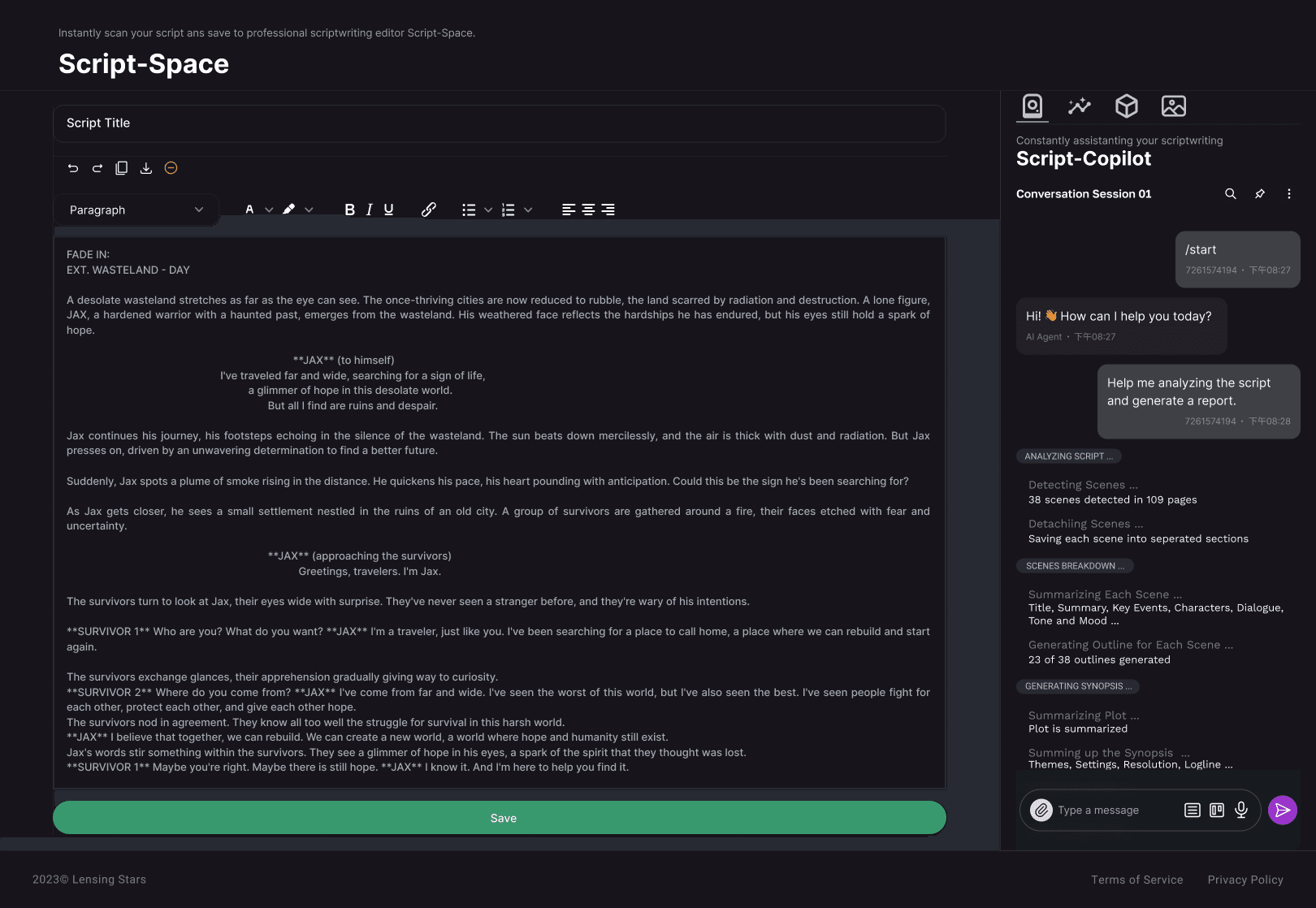
Direction taken
Defined, progressive stages
Logline through review, each stage inheriting the last — replacing the blank canvas with a visible path from story structure to visual production, architected from the start as a documented component system rather than one-off screens.
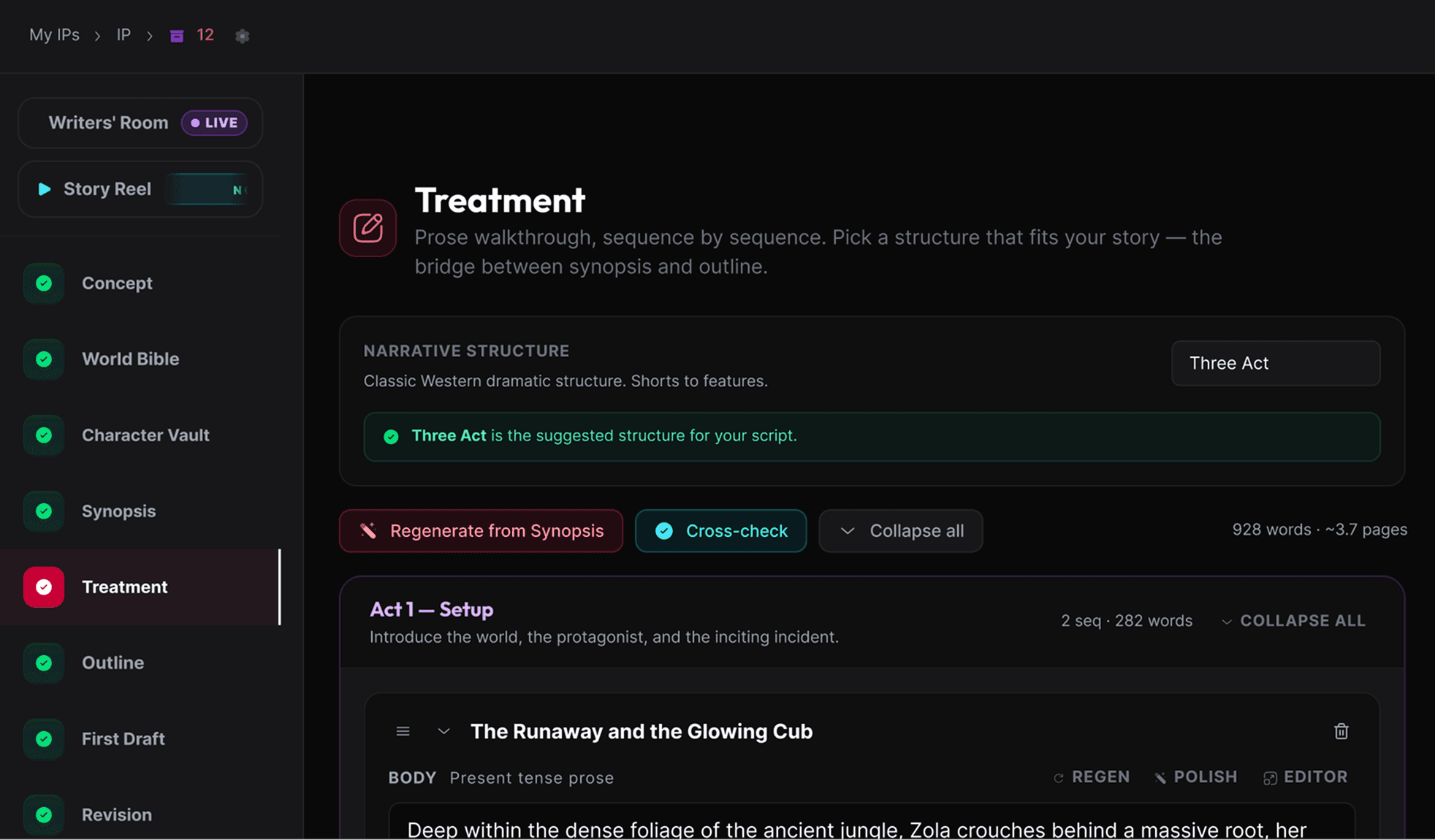
Built on a moving target.
AI video-generation capability shifted underneath the product three times over three years. Staying controllable for creators meant re-grounding the design in what the models could actually do, and in what creators told us they were afraid of losing.
Band A — Model evolution
2022
Script assistance
AI-assisted generation and research support.
2023–24
Visual generation
Script generation wired directly to text-to-video models.
2025
Production system
A context-aware, script-to-production studio.
Optional depth — what shifted each era
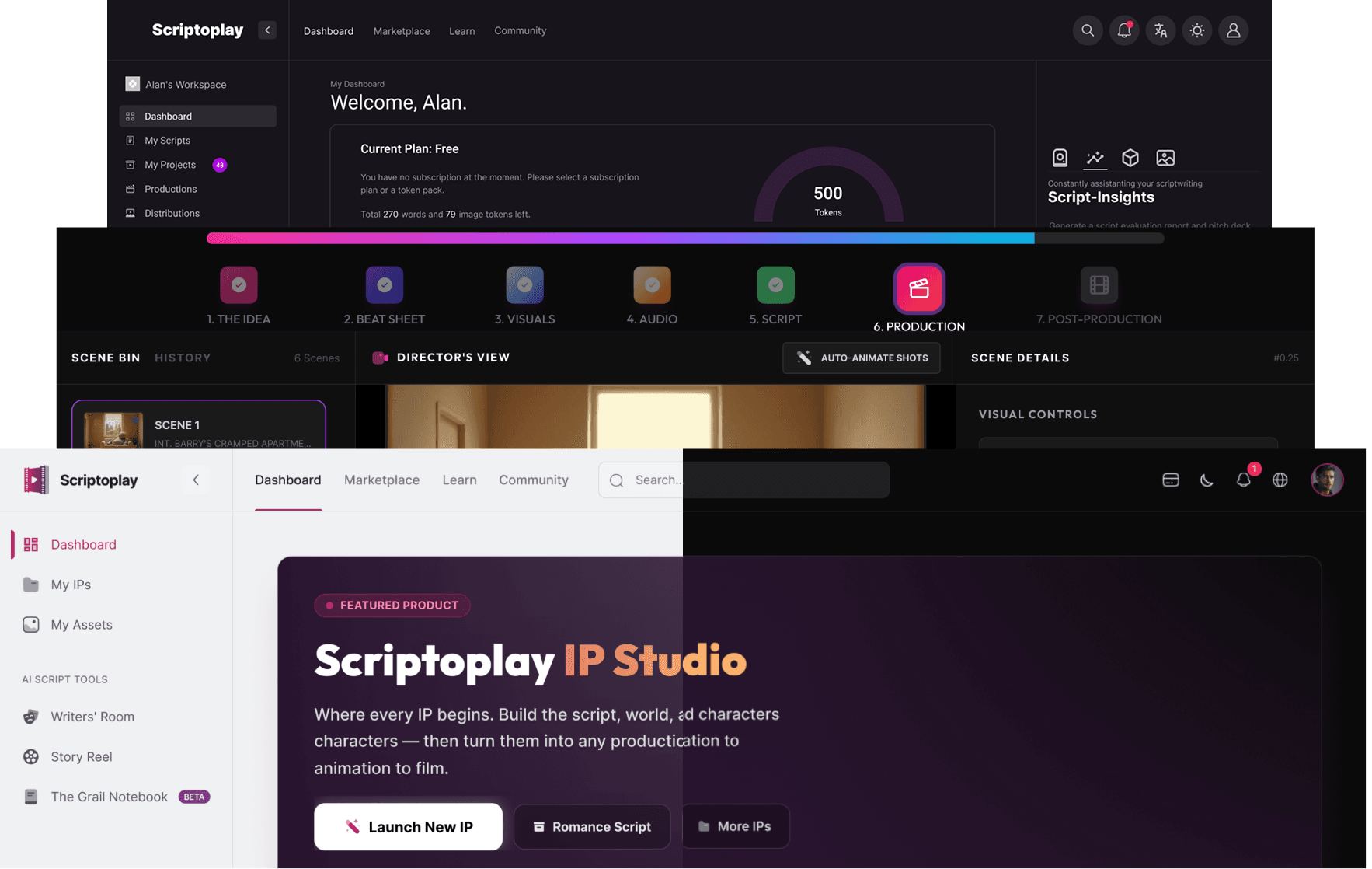
- Era I · AI script assistant (2022) — Generation and chatbot research support, with blockchain-based IP minting and a script marketplace explored early — before focus narrowed back to the core writing workflow.
- Era II · Prompt-to-video integration (2023–24) — Script generation wired directly to text-to-video models — but short, fixed-length clips and limited reference-image input constrained what a scene could actually become.
- Era III · IP Studio (2025) — Reference-to-video models matured enough to hold character and scene continuity across longer generations, repositioning the product from a script-writing tool into a full script-to-production studio.
Band B — Research translated into product
Control
Creators feared losing authorship
Review · lock · approve
Continuity
Context broke across tools
Persistent project context
Simulation
Creators needed to test ideas
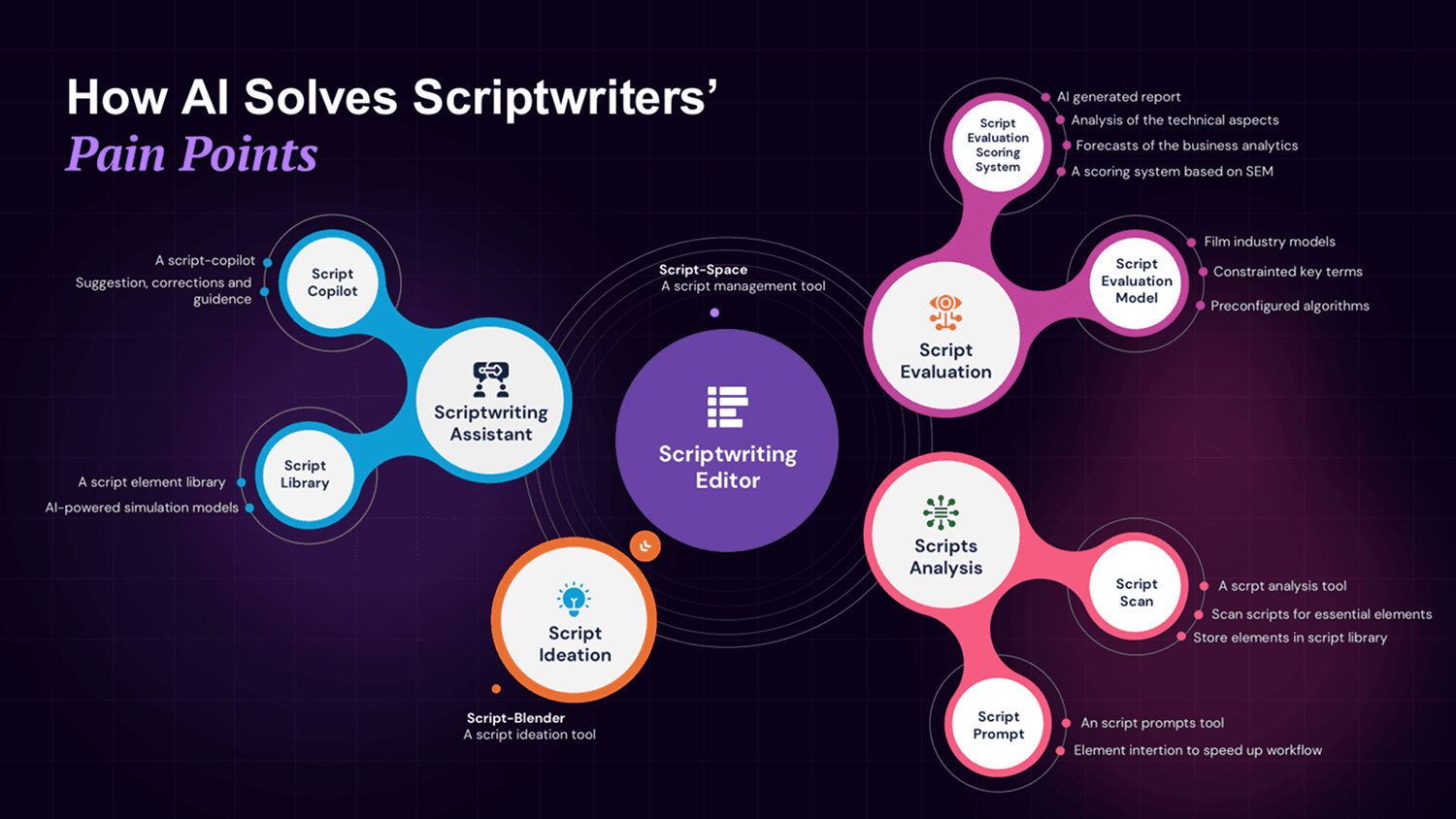
Writers’ Room
Who this was for
Interviews surfaced four recurring creator archetypes — a writer-director balancing vision against budget, a script consultant drowning in messy drafts, a film student who wants to know why something’s wrong, and a freelance screenwriter tired of submitting into a void. Alex Ramirez, the freelance screenwriter, became the primary persona the pipeline was designed around: someone who didn’t need another tutorial, but a creative partner who understood the story well enough to say what mattered.
Alex Ramirez
Freelance Screenwriter · Primary persona
“I don’t need another YouTube tutorial — I need a creative partner who gets my story.”
Optional depth — all four personas
Samira Belkacem
Writer-Director
“Vision is only power when it’s doable on a set.”
Frustrations
- Rewriting scripts because they’re too expensive to shoot.
- Lack of tools that understand both narrative and production.
Maya Daniels
Script Consultant
“Great stories hide in messy drafts — I just need to find them faster.”
Needs
- Script scoring and rating assistance.
- Pacing, tone, and structure evaluations at scale.
- Collaborative comment tools that organize thoughts per scene.
Jordan Kim
Film & Television Student
“Tell me what’s wrong — but also tell me why and how to fix it.”
Needs
- Clear, actionable advice on how to improve.
- Educational insights tied to real-world examples.
- Guidance on script structure and formatting.
Alex Ramirez
Freelance Screenwriter
“I don’t need another YouTube tutorial — I need a creative partner who gets my story.”
Frustrations
- Getting ghosted after submitting scripts.
- Time wasted revising without knowing what matters.
Featured persona
Alex Ramirez
Freelance Screenwriter
Alex transitioned into screenwriting after years in the advertising world. He’s written three feature-length scripts and several shorts, mostly working late nights and weekends. He’s passionate about telling character-driven stories with strong emotional arcs. He dreams of landing a script option with an indie studio but struggles to get consistent, high-quality feedback.
Age
34
Location
Austin, TX
Occupation
Freelance Screenwriter
Experience
5 yrs of screenwriting
“I don’t need another YouTube tutorial — I need a creative partner who gets my story.”
Needs
- Honest, constructive feedback — fast
- Script viability checks for indie producers
- Automated formatting and error correction
- Collaborative comment tools that organize thoughts per scene
Frustrations
- Getting ghosted after submitting scripts
- Time wasted revising without knowing what matters
- Repeating the same structural notes to different writers
- Sifting through 100+ pages just to realize a story doesn’t work
Nine phases, one continuous script.
Every script moves through the same nine phases, from a one-line spark to a locked final draft. The script itself stays the human-readable narrative artifact — a structured project context layer is what every downstream asset — image, voice, video — actually reads from, so nothing gets re-authored per surface.
Key message
“The script is the human-readable artifact. The structured context is the production infrastructure.”
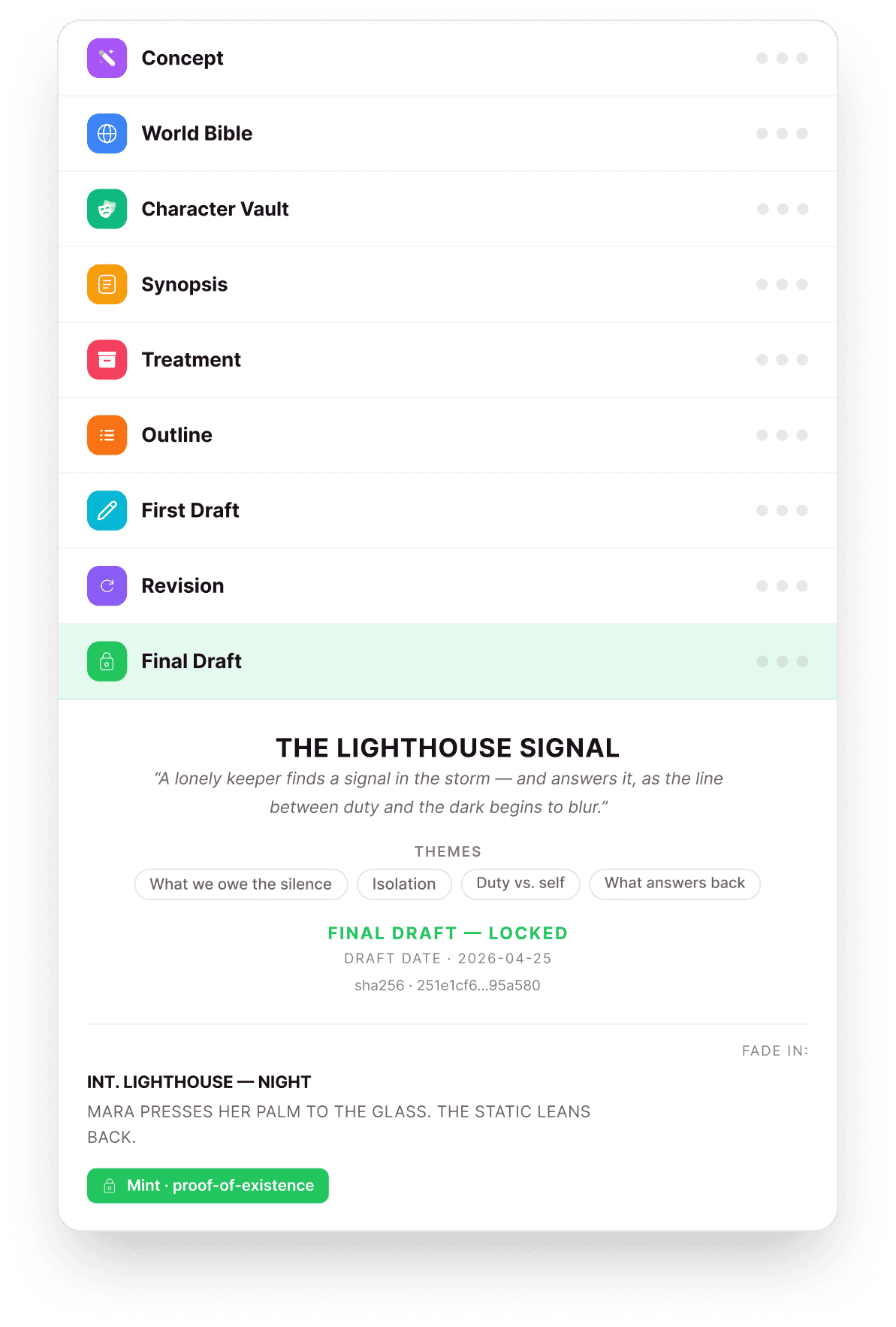
Three layers, one system
Creative development
The human-readable script and story.
Structured project context
The infrastructure every downstream asset reads from.
Production
Generated from context, not re-authored per surface.
“The script is the human-readable artifact. The structured context is the production infrastructure.”
Optional depth — same spine, different shape
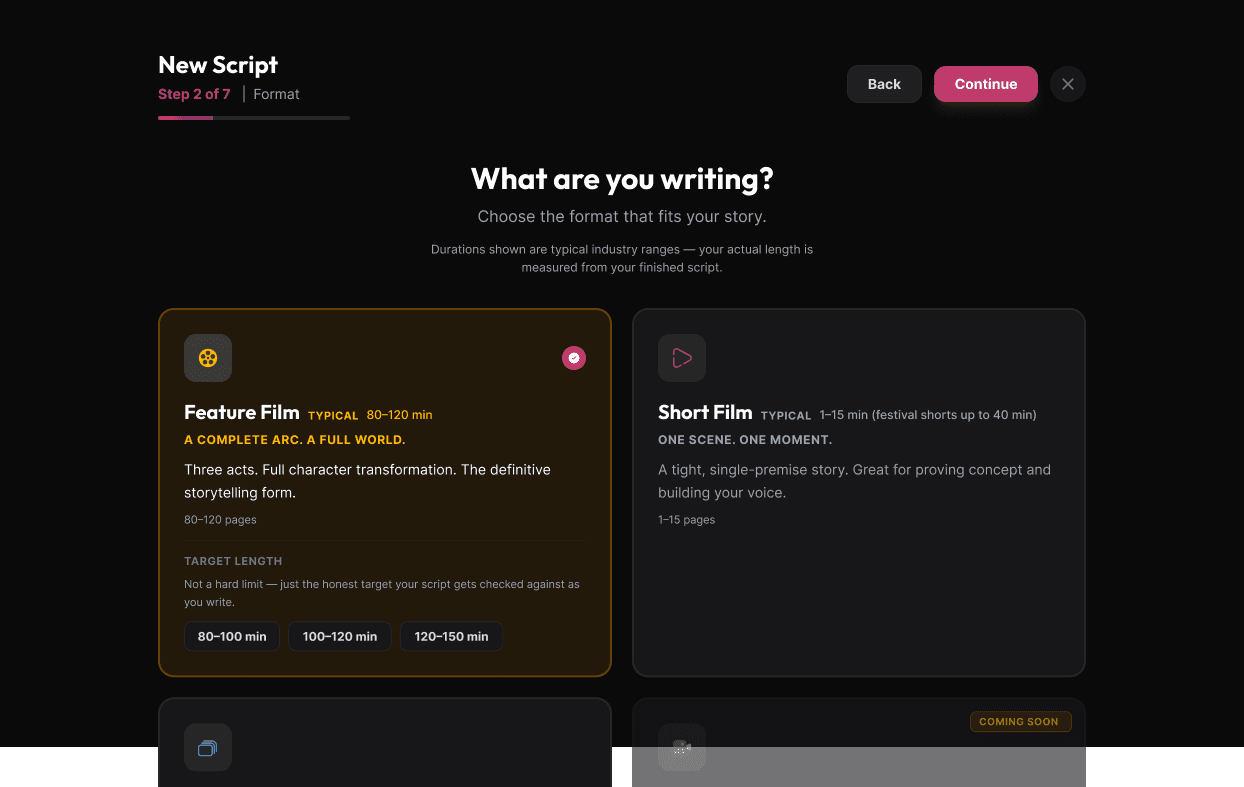
A Feature, a Short, and a Series Episode aren’t the same writing job — same product architecture, different structural manifest.
Feature
Full long-form progression — all 9 phases.
Short
Compressed workflow, lighter footprint, same spine.
Series
Shared world + inherited episode context.
From idea to production.
The journey was mapped end to end — from a first idea through story development, structured assets, and scripting, to production — so continuity and control stay visible across every handoff, not just within the writing phase. The flow wasn’t shipped once and left alone: A/B testing, QA passes, and a continuous creator feedback loop kept it under active iteration.
Idea
Script Blender
Mixes genres and prompts to spark a concept.
Replaces the blank canvas with a starting structure.
Story Development
Writers’ Room
The Scene Simulator, Scenario Lab, and Specialist Advisors let creators rehearse and stress-test a story before committing to the page.
Gives creators a way to test a story, not just write it once and hope.
Structured Assets
World Bible · Character Vault
Characters, locations, and identity generated and locked as persistent project context.
Locks continuity before it can break across tools or surfaces.
Script
Nine-Phase Pipeline
The locked context carries the script from first draft to a locked final draft.
Keeps every downstream asset reading from one source, not re-authored per surface.
Production
Promote to Production · Production Studio
A locked script and its structured context move into shot-by-shot planning, generation, and review.
Keeps generation reviewable and approvable, not automatic — the connected journey’s current destination.
Branches after production
Marketplace and IP monetizationFuture exploration were explored as a possible ecosystem extension — not part of the shipped or in-development product this case study describes.
Detailed flow — real journey map
Production Studio: in development / next major stage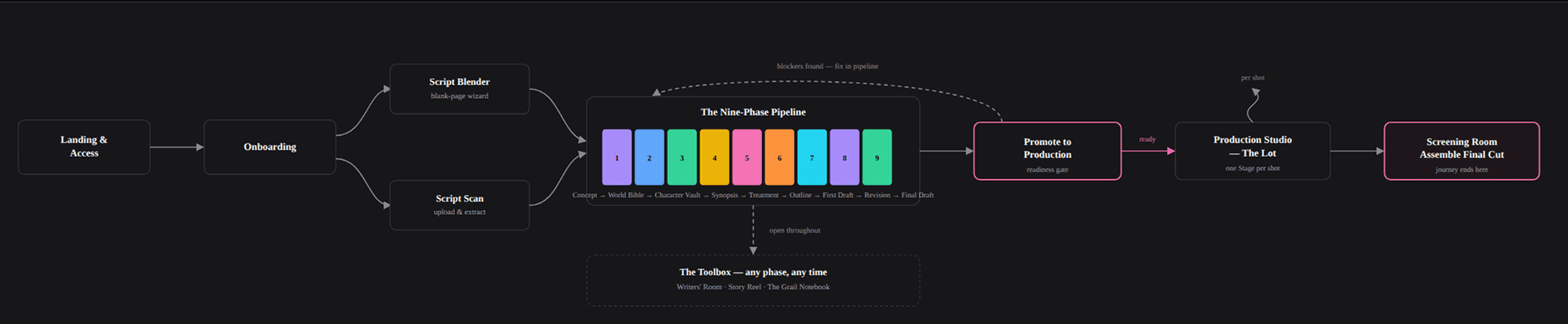
Validation notes
A/B testing — Flow variants compared against real usage before committing to one path.·QA passes — Structured checks against the flow before every release.·Feedback-loop iteration — Continuous refinement from creator feedback after launch — not a one-time research pass.
AI output is never treated as final by default.
Six states — generate, inspect, compare, regenerate, approve, recover — were defined once as a reusable component spec, not redrawn per screen. Every generation passes through the same checkpoints creators can see and act on, so control isn’t something they have to ask for.
Generate
Capture creative intent and constraints, then generate — busy is shown as busy, not stalled.
Inspect
Preview a result in context before committing to it.
Compare
Weigh multiple generations side by side instead of picking blind.
Regenerate
Retry with one variable changed — context stays intact.
Approve
Approved results become the project’s canonical state — the reference every later phase builds on.
Recover
A failed generation loses the attempt, never the project context.
One real interface — truthfully annotated
Current phase stays visible
The active creative stage remains clearly anchored in the larger workflow.
Completed work remains accessible
Earlier phases stay visible instead of disappearing after completion.
One bad category can’t hide behind a good average.
Alex Ramirez’s frustration wasn’t a lack of feedback — it was feedback with no way to act on it. The Script Analyzer scores a script across ten AI-judged categories against a written rubric.
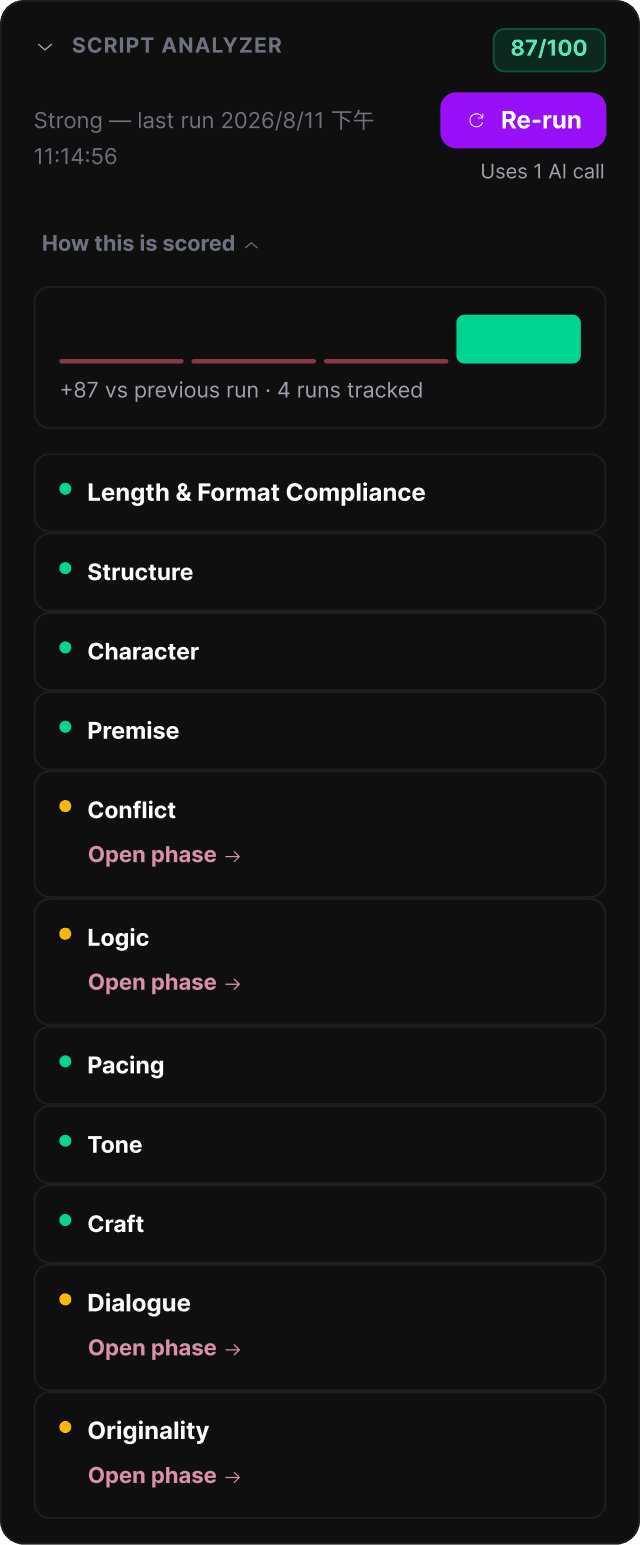
Category scoring
Individual weaknesses stay visible instead of disappearing inside an average.
Evidence + fix
Flagged categories are grounded in specific script evidence, paired with a concrete fix.
Open phase + rerun
Creators jump straight to the relevant phase, revise, and re-run to verify the fix worked.
Quality gate: a severe Length & Format failure caps the overall score outright — bad caps it at 40, okay at 70 — so one catastrophic problem can’t hide behind a good average.
A system that survives implementation.
One token system carries every theme and screen; the same system connected directly into the shipped codebase, so parity was checked in code, not assumed from a spec doc.
Part A · System
Light / dark
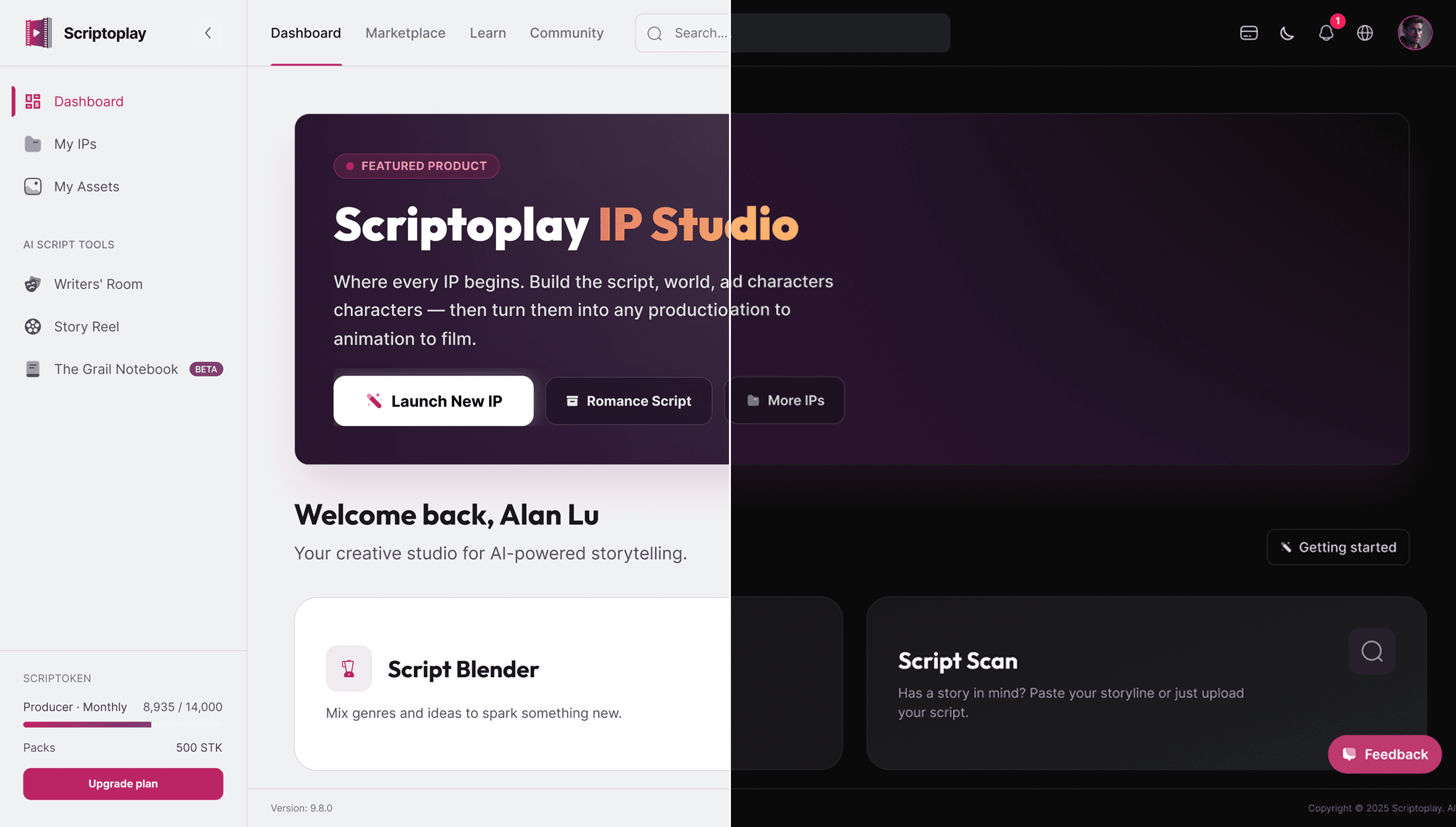
Brand tokens
Phase-identity tokens
Responsive layout
Desktop
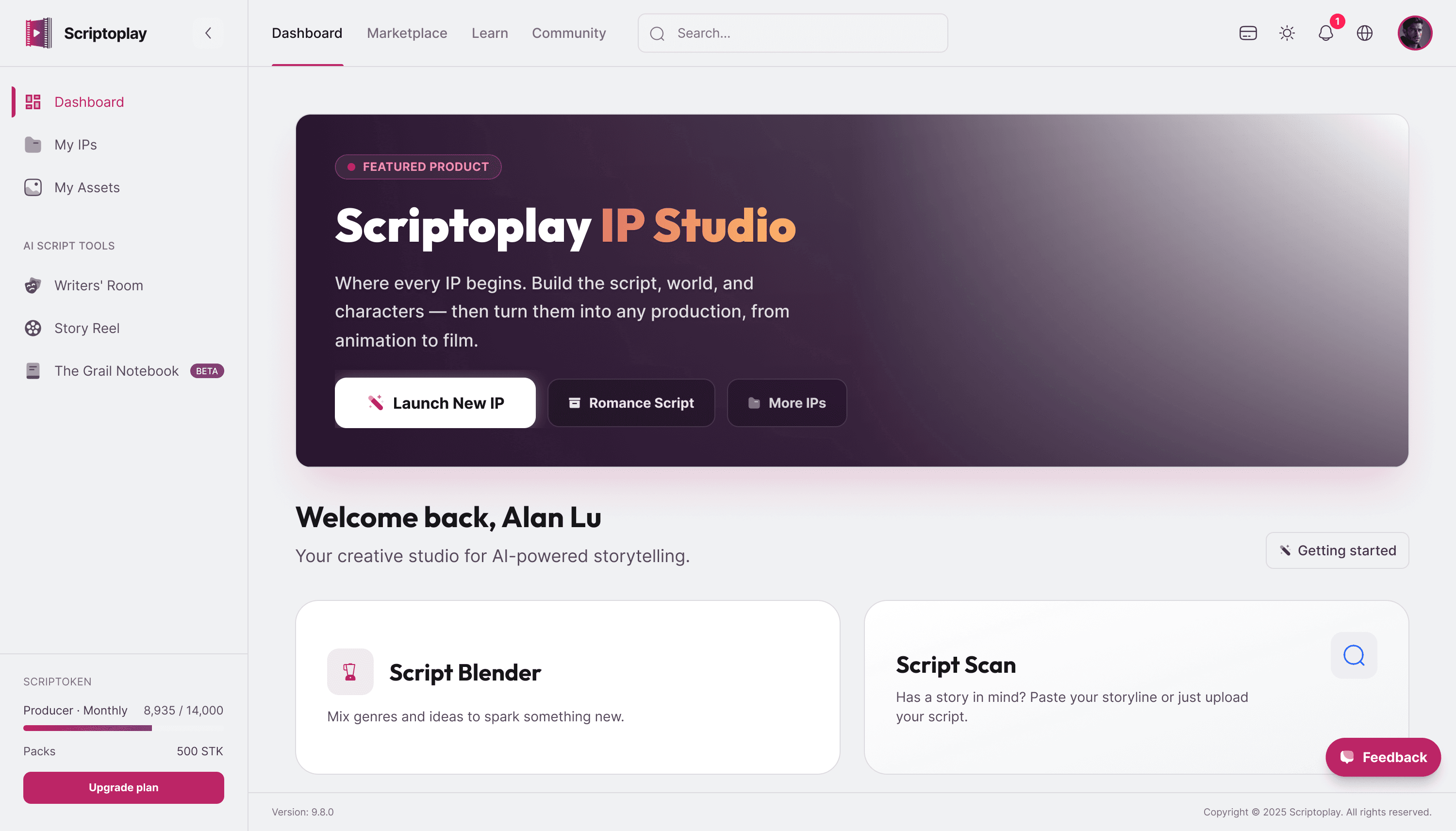
Tablet
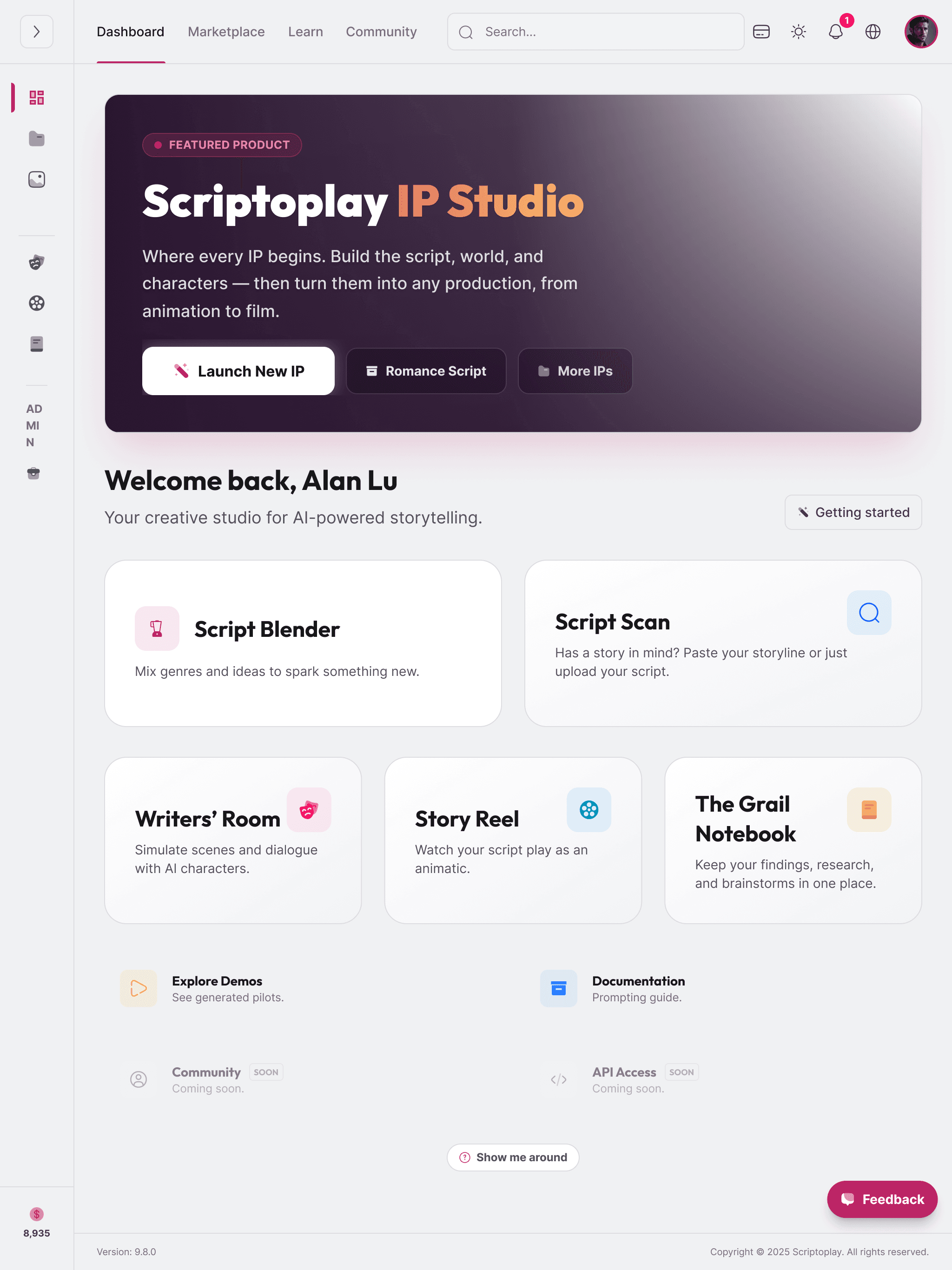
Mobile

SpotlightTour
A reusable onboarding pattern, not one-off walkthroughs built per feature — a small proof point, not the main story.
1 reusable interaction engine → 20+ onboarding tours across 3 surfaces
Part B · Delivery
Built in Figma, verified in Git.
Shared semantic values were validated against the implemented product rather than treated as a static handoff spec.
What changed.
Product
Disconnected AI tools
a structured story-to-production system
Story development and visual production operate as one connected project instead of separate tools.
Creator
Open-ended generation
inspectable, controllable AI collaboration
Generation states, comparison, and approval give creators authorship over the outcome instead of asking them to accept whatever the model returns.
System
One-off interactions
reusable AI states and persistent context
Generate through recover are defined once as reusable specs, and context — characters, locations, identity — persists across the pipeline instead of being re-established per surface.
Delivery
Static handoff
code-aligned design system
Figma Variables ran through Style Dictionary into the same values the app consumed, checked against shipped CSS states, not assumed from a spec doc.
Learning
Generation cost is a UX constraint, not just an engineering constraint.
Model choice, reference count, retries, previews, and regeneration paths all affect both creator experience and operating cost.
Next project
MyGoDeFi property transactions